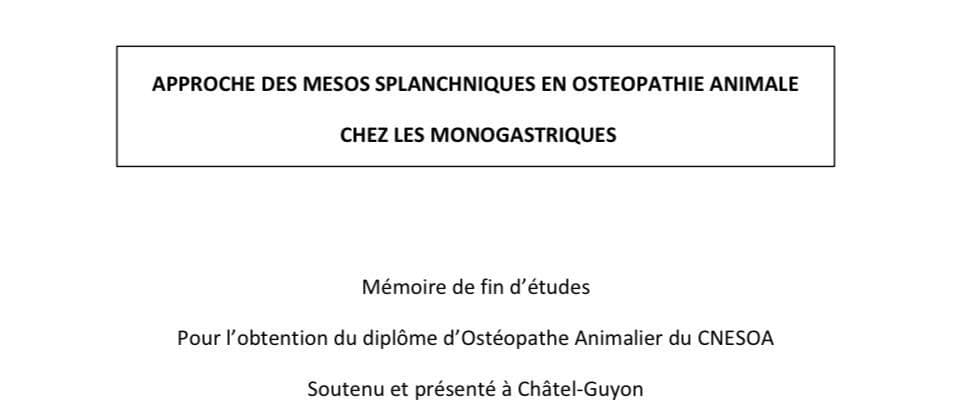
On completing my training in animal osteopathy, I defended my final-year dissertation, entitled “Approche des mésosplanchniques en ostéopathie animale chez les monogastriques” (An approach to the mesosplanchnic structures in animal osteopathy in monogastric animals).
This research looks at the mesosplanchnic structures, essential fascial structures involved in the suspension, support and mobility of the thoracic and abdominal viscera. The aim was to gain a better understanding of their anatomical organisation and of their relevance to the practice of animal osteopathy.
The dissertation is organised in two main parts.
The first is devoted to the theoretical and osteopathic foundations of the fasciae and mesosplanchnic structures. It covers the histology and physiology of connective tissue, the classification of fasciae and their embryological development. This work leads to an original proposal for mapping the main mesosplanchnic structures of the thoracic and abdominal sphere in monogastric animals. This synthesis aims to offer a more coherent view of these fascial continuities, which are often described in a fragmented way in the literature.
The second part traces the evolution of the visceral and fascial approach in osteopathy, in both human and animal osteopathy. By revisiting the writings of the founders of the discipline and of the main authors who contributed to its development, this work puts into perspective how concepts and the treatment of visceral and fascial structures have evolved over time.
Finally, the dissertation concludes with a practical proposal for an osteopathic approach to the mesosplanchnic structures. This approach draws on their anatomy to make them a tool for assessment and clinical reasoning, particularly for osteopathic diagnosis and the treatment of visceral dysfunctions. It also reflects a desire to make the osteopathic examination more objective, in order to encourage dialogue with veterinary medicine and to position osteopathic reasoning as a complement to veterinary diagnosis.
Beyond earning the diploma, this dissertation is a contribution to the discussion on the place of fasciae and mesosplanchnic structures in animal osteopathy. It reflects a commitment to grounding clinical practice in an in-depth understanding of anatomy, embryology and tissue continuities, in order to enrich osteopathic reasoning. It also affirms the value of the mesosplanchnic structures as the basis of a rigorous osteopathic diagnostic approach, one that can fit into multidisciplinary care alongside the veterinary clinical examination and diagnosis.